
How Often Should I Clean My Windows?
For most homes, windows should be cleaned every 4 to 8 weeks. If the property is close to the coast, exposed to wind, used as a holiday let, or has large areas of glass, every 4 weeks is usually the better minimum. For commercial properties, luxury accommodation, shops, cafés, restaurants and other high-presentation spaces, fortnightly or weekly cleaning is often more appropriate.
The honest answer is this: window cleaning frequency is not just about whether the glass is dirty. It is about how the property feels.
Clean windows make a home feel cared for. Dirty windows make even a beautiful property look tired. This is especially true for coastal homes, holiday lets and businesses where first impressions matter.
After more than 20 years cleaning windows in coastal towns such as St Ives, Carbis Bay, Lelant and Hayle, the team at Smith Cleaning Limited have found that the right cleaning schedule depends on exposure, property use, weather, sea air, footfall and the standard of presentation the owner expects.
The Short Answer
As a general guide:
-
Normal family home: every 4 to 8 weeks
-
Sheltered rural home: every 8 weeks may be acceptable
-
Coastal home: every 4 weeks
-
Sea-facing property: every 4 weeks as a minimum
-
Holiday let: every 2 weeks during the active season
-
High-end or 5-star holiday accommodation: weekly touch-ups may be needed
-
Shops, cafés, restaurants, spas, gyms and offices: weekly or fortnightly
-
Commercial frontage: weekly to monthly depending on footfall and exposure
For most domestic customers, 4-weekly cleaning service is the sweet spot.
By the end of 4 weeks, particularly in coastal areas, you usually start to notice the windows need attention again. The difference is that the property has not yet dropped into looking neglected.
Why Coastal Windows Need Cleaning More Often
Coastal windows get dirty in a very particular way.
If you own a sea-facing home, you will usually start to notice salt build-up by the end of 4 weeks. You may also see sand collecting in tracks, spiders’ webs around frames, and a general dullness on the glass. This becomes especially noticeable from April through to October when there is more sunshine.
Cornwall has a damp, sunny, coastal climate. That combination can encourage green algae, spider activity, salt deposits and wind-blown sand. A 6-weekly clean may work well in less salty places, but on many Cornish coastal properties it can be slightly too long if you want the property looking consistently cared for.
What affects coastal windows?
In coastal areas, windows are not just getting dusty. They are being affected by:
-
Salt in the air
-
Wind-blown sand
-
Sea mist
-
Spiders and insects
-
Bird mess
-
Pollen
-
Algae
-
Damp corners
-
Touch points on doors and glass
-
Dogs pressing noses and paws on patio doors
-
Guest fingerprints on large glass areas
The closer the property is to the sea, the more these things matter.

Rain Does Not Make Window Cleaning Pointless
One of the biggest misunderstandings about window cleaning is the idea that rain makes it pointless.
Rain does not usually make clean glass dirty by itself. What it often does is move existing dirt around. It partially washes away some dirt, then concentrates the rest into lines and streaks that become more obvious when they dry.
This is why windows can look worse after rain if they were already dirty.
Traditional window cleaning and rain
There is a difference between older traditional methods and modern pure water cleaning.
Traditional window cleaning with an applicator and squeegee can give excellent results, but if soap residue is pushed into seals, rubbers and corners, later rain can sometimes reactivate those residues and cause runs.
That does not mean the clean was pointless. Even with traditional methods, most of the dirt has still been removed and the windows will usually look far better than before. But it does explain why some homeowners have come to believe that rain and window cleaning do not go together.
Modern pure water cleaning and rain
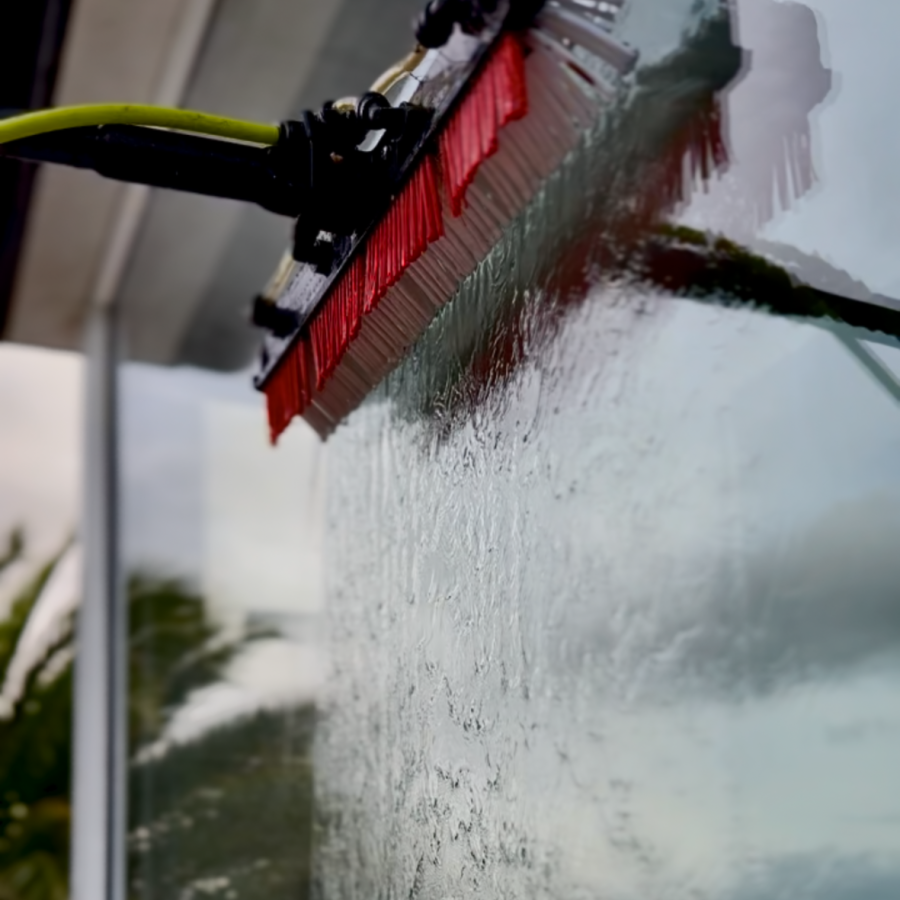
Modern water fed pole systems work differently. They use purified water, often called deionised water, which has had the minerals removed. Because the water is low in dissolved minerals, it can dry naturally without leaving the same spotting you would get from ordinary tap water.
Rainwater is naturally low in minerals before it picks up dirt from the air, roofs, frames or surrounding surfaces. So when windows are cleaned properly using purified water, rain is not the enemy people often think it is.
In fact, during wet weather, pure water cleaning can work extremely well because the dirt is already softened. The key is proper technique, clean frames, clean seals and enough rinsing.

What Makes Windows Dirty Faster?
to open and close doors. They also come from children touching the glass, guests using patio doors, or dogs getting excited to come in and out.
Bird strikes and bird mess are another major issue, especially in seaside towns. If these marks are left in the sun, they can bake onto the glass and become much harder to remove.
Pollinator marks can be surprisingly stubborn
Pollinator strikes are another mark many people underestimate. Bees, flies and other insects can hit the glass and leave a small splat of grease and pollen. These can be surprisingly stubborn.
Hot pure water is particularly helpful here because it soaks and softens the mark before it is scrubbed away.
Frames, Seals and Tracks Matter Too
Good window cleaning is not just about the glass.
Frames, sills, seals, rubbers and tracks all collect dirt. If they are ignored for too long, the whole window system starts to look tired, even if the glass itself is cleaned.
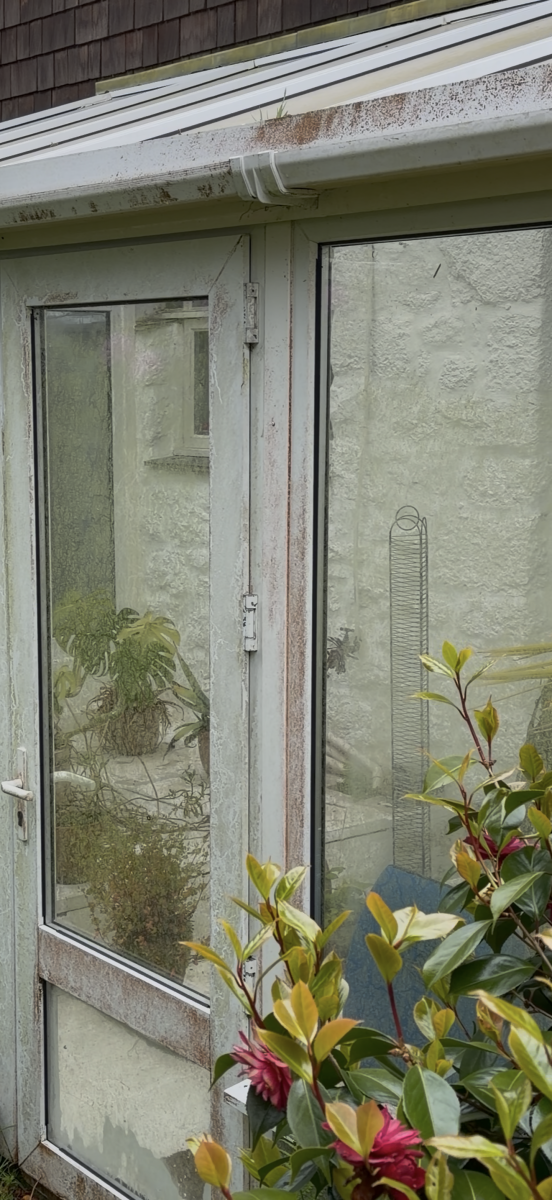
Older aluminium and plastic frames can oxidise in the sun. When they are washed, they can sometimes release a milky residue. If that residue runs onto the glass and dries, it can leave marks that are very noticeable, and in some cases difficult to fully remove.
An inexperienced window cleaner may not always spot this happening. An experienced cleaner will understand how different frames behave, especially on older coastal properties.
Regular cleaning can help reduce the build-up of dirt, algae and oxidisation around frames and seals. It is not just cosmetic maintenance. It helps keep the whole window area in better condition.

Wind-Blown Sand Is a Bigger Problem Than People Realise
People who do not live or work near the coast are often surprised by how much sand is carried in the wind.
After a day of window cleaning in coastal areas, the inside of a van can be covered in sand. That same sand is being blown onto cars, window sills, tracks and glass.
When sand mixes with salt and moisture, it can quickly make windows look dull and gritty. Tracks around sliding doors and patio doors can become especially dirty.
This is one reason why coastal homes often need a shorter cleaning cycle than inland
Historic Stone and Sandstone Properties Need Particular Care
Some properties need more care because of the materials around the windows.
Older sandstone walls are a good example. When sandstone gets wet, it can run down onto the windows and frames below, leaving salty or mineral-looking streaks on the glass.
We see this when cleaning older historic buildings in St Ives. If these properties are cleaned in the same way as a modern home, the results can be disappointing because the surrounding stonework can contaminate the clean glass.
This is where experience matters. The window cleaner needs to understand not just the glass, but the building around it.
Why Waiting Longer Can Cost More
Many homeowners assume that stretching the time between window cleans saves money.
Sometimes it does. A sheltered country property, away from the sea, with little traffic, low wind exposure and minimal tree cover may be perfectly fine on an 8-weekly clean.
But that does not apply to every property.
On coastal homes, holiday lets and properties with large areas of glass, waiting too long can create more work. Dirt gets into seals and tracks. Algae starts to form. Bird strikes bake onto glass. Frames become harder to bring back. The clean takes longer and the result may still not be as good as regular maintenance would have been.
What happens when windows are left too long?
A 12-weekly clean can work for some people, but it does allow more time for dirt to settle into awkward areas such as:
-
Window seals
-
Door tracks
-
Corners
-
Glass balustrades
-
Frames
-
Sills
-
High-level glass
-
Sheltered damp areas
A 4-weekly clean keeps this at bay. The surfaces are being maintained before they become a bigger job.
A Real Example of Leaving Windows Too Long
We were once asked to look at a beautiful large 1960s property with a studio annex. It had not been cleaned properly for around 18 months.
The owner wanted the windows and frames cleaned. The problem was that the building had gone beyond a normal window clean. There was such a heavy organic build-up that the whole property needed a biocide wash first.
There were several types of algae colonising the glass and frames. In places, you could scratch into the algae on the glass. It was that established.
The cost to deal with the contamination properly was many times more than a regular window clean would have been. Unfortunately, the owner was not in a position to spend that amount, and the frames continued to deteriorate.
The lesson is simple. Regular maintenance is almost always cheaper than restoration.
The Hidden Cost of Reactive Window Cleaning
We have also seen the difference between planned maintenance and reactive cleaning on holiday properties.
One holiday agency we worked with for over a decade had more than 40 properties on a regular maintenance schedule. The properties looked excellent throughout the year. Visitors would walk past, look through the windows, and imagine staying there on a future visit. The properties had kerb appeal.
Then a new manager took over and reduced window cleaning visits to save money. Winter cleans were cut back. Summer visits became more reactive and tied to guest arrivals.
On paper, that sounds sensible. In practice, especially on the coast, it caused problems.
After 12 months, the properties looked more tired. There were more complaints about properties appearing unkept. Guest satisfaction dropped, bills became less predictable, and the overall presentation declined.
The issue with reactive cleaning is that by the time the windows are visibly poor, the property has already lost some of its appeal.
In contrast, properties we still maintain weekly or fortnightly for other agents keep their market appeal. Guests notice the views, not the marks on the glass. They leave positive reviews and want to return.
For holiday accommodation, window cleaning is not just a maintenance task. It is part of the guest experience.
When Is 8-Weekly Window Cleaning Acceptable?
An 8-weekly schedule can work well for certain properties.
It is most suitable when the property is:
- Not directly facing the sea
- Sheltered from strong coastal wind
- Away from heavy traffic
- Not surrounded by heavy tree cover
- Not used commercially
- Not presented as luxury accommodation
- In a rural or semi-rural setting
- Less affected by sand, salt and bird mess
Even then, 8 weeks can sometimes become 9 or 10 weeks because of weather, scheduling and other work. By that point, even sheltered properties can start to show algae, dirt and dullness.
So 8-weekly cleaning can be fine, but it should be chosen carefully.
When Should You Avoid Leaving It Too Long?
You should avoid long gaps between window cleans if the property is:
- Close to the sea
- Sea-facing
- Used as a holiday let
- Marketed as luxury accommodation
- Used for business
- Surrounded by damp walls or algae-prone areas
- Exposed to wind-blown sand
- Affected by gulls or nesting birds
- Full of large glass doors or balustrades
- Used by guests, children or dogs
- Important for first impressions
If presentation matters, longer gaps usually work against you.
My Honest Recommendation
If it was my property, I would choose the schedule based on how the property is used and how exposed it is.
For a normal home, I would usually recommend every 4 to 8 weeks.
For most coastal homes, I would recommend every 4 weeks.
For sheltered rural homes away from the sea, 8-weekly may be perfectly acceptable.
For holiday lets, I would recommend fortnightly during the active season.
For high-end holiday accommodation, I would strongly consider weekly touch-ups, especially on the main glass, patio doors and sea-facing windows.
For shops, cafés, restaurants, spas, gyms and offices, I would recommend weekly or fortnightly depending on footfall.
The main point is this: the right frequency is not just about cleaning dirt from glass. It is about maintaining the standard of the property.
A regular window cleaning schedule keeps the glass clearer, the frames cleaner, the sills better maintained and the property looking cared for.
Waiting longer can look cheaper at first, but on exposed properties it can lead to more dirt, more algae, poorer presentation and higher costs later.
Clean windows are not just about seeing out. They affect how a home feels, how guests experience a property, and how well a building presents itself.
For properties where appearance matters, regular window cleaning is not a luxury. It is part of good property care.